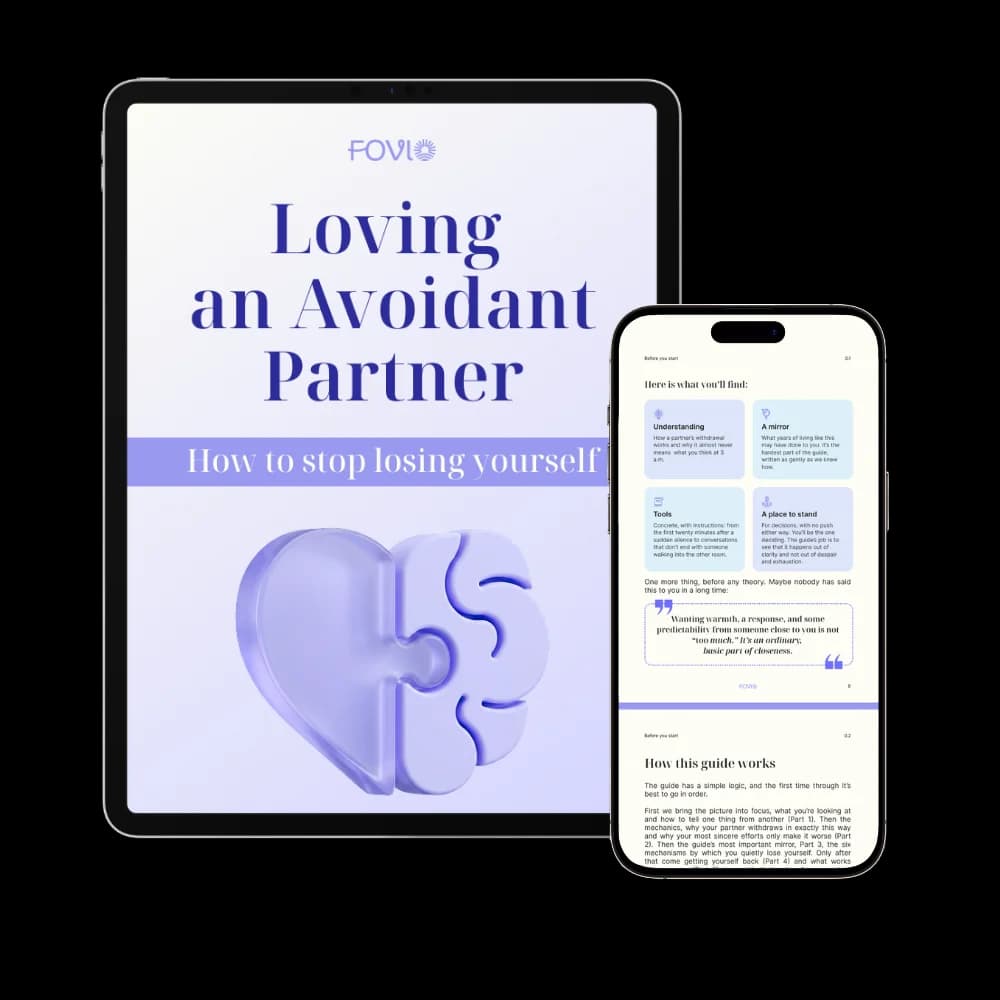
Grounded in psychology
Research on breakups, attachment and emotions - in plain language.
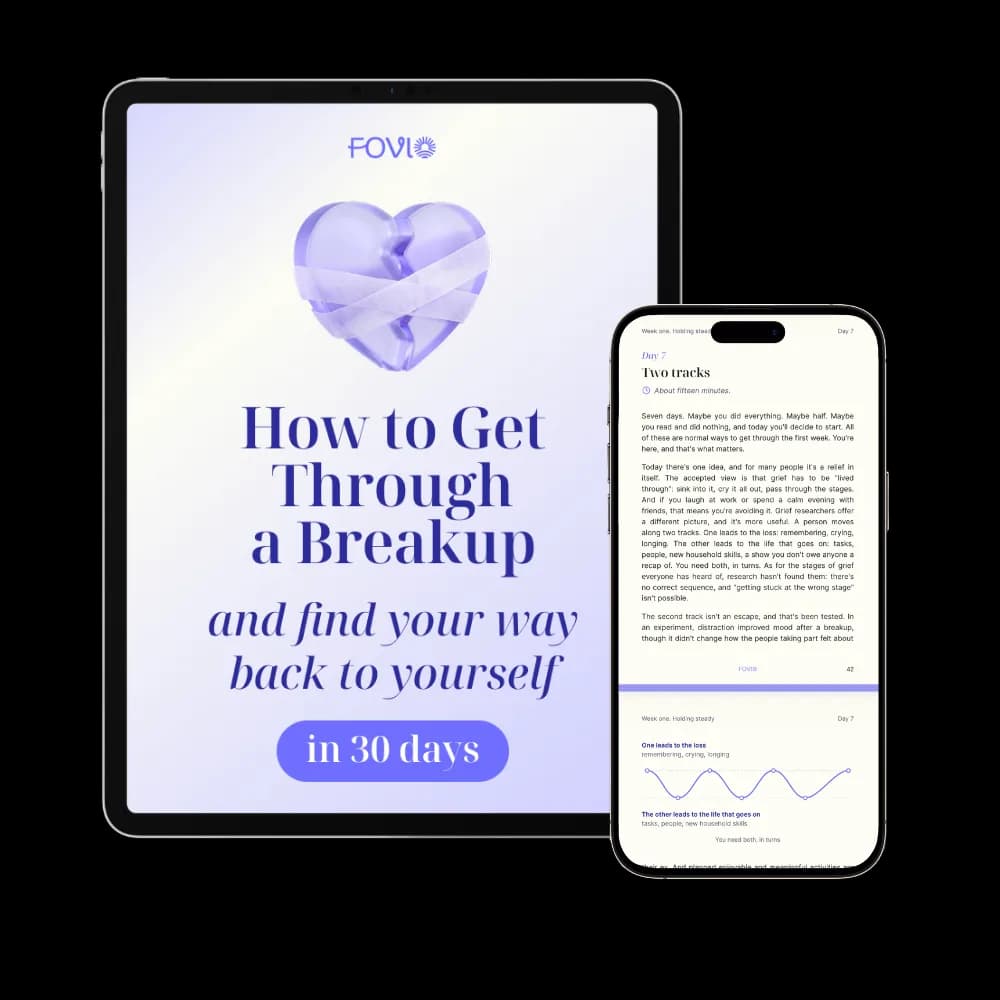
A practical Fovio guide
This guide is for anyone who is struggling after a breakup right now: when your hand reaches for the phone on its own and your mind keeps replaying the same conversation.
You don't need to know what to do next. The guide walks you through it step by step: one short practice a day, 10-15 minutes each. Inside are 24 tools and ready-made plans for the hardest moments - when you want to text, when it hurts badly and when loneliness hits.
€33.99
Buy the guideA PDF, sent to your email right after payment. The sale is handled by our payment partner Paddle. Details: Terms · Refunds
Research on breakups, attachment and emotions - in plain language.

One short practice a day that helps you move through the pain of a breakup.

A handy PDF arrives in your inbox after purchase.
You'll know what to do when the pain hits, and you'll stop facing it completely alone.
The urges will still come, but you'll learn to ride them out without doing things you regret afterwards.
Your thoughts will stop circling for hours, and you'll stop blaming yourself for everything that happened.
Step by step the clarity comes back: who you are, what matters to you and what you want - whoever is or isn't beside you.
You'll get back the sense that life goes on and that closeness is possible for you again.
Why a breakup hurts this much, why your hand reaches for the phone and why your thoughts circle. In plain language, with no labels and no diagnoses.
One small step a day, 10-15 minutes each. Nothing to decide or plan: you simply open the next day. And when you're running on empty, every step has a two-minute version.
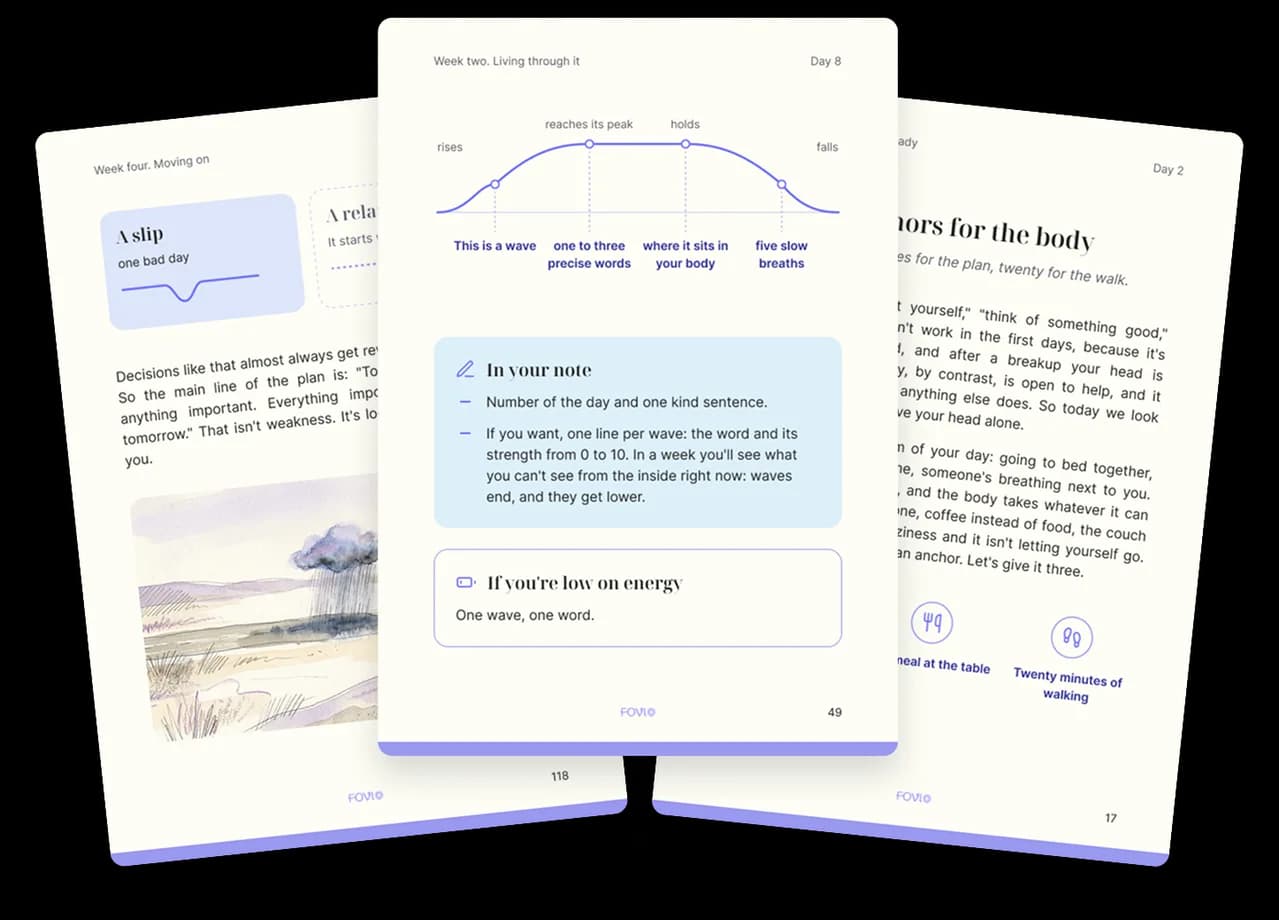
What to do when it hurts badly, when you want to text and when loneliness hits. They're always at hand on your phone.
Small tasks and questions that help you understand again who you are, what matters to you and what you can lean on.
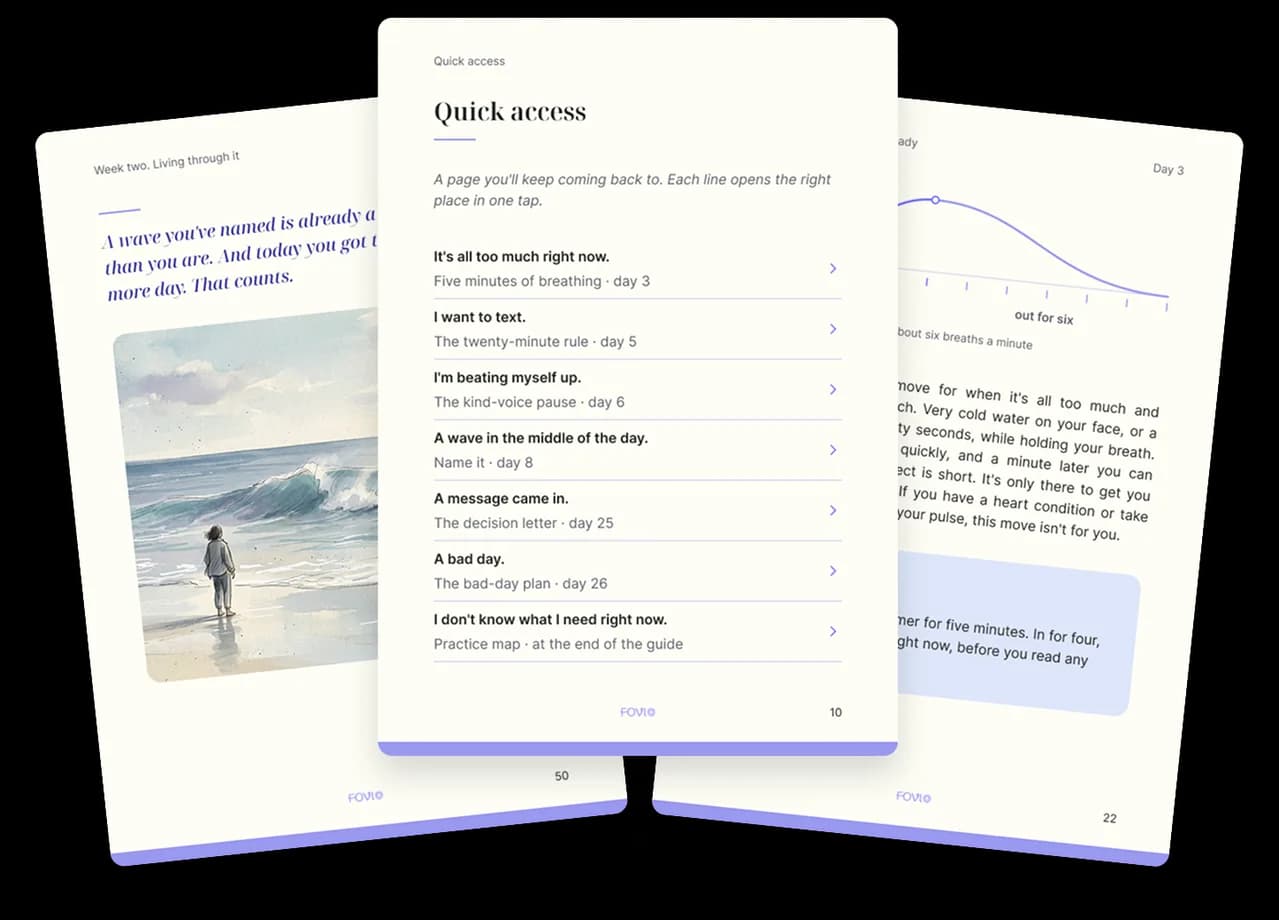
Not on social media advice. On research into how people live through breakups and what actually helps.
The Fovio team built this guide on scientific work about breakups, attachment and coping with intense feelings and intrusive thoughts. It includes only practices that are supported by research and easy to do on your own.
In preparing the material we drew on the scientific concepts and findings published by David Sbarra, Kristin Neff, Ethan Kross, Margaret Stroebe, Peter Gollwitzer and other researchers. The guide is not a retelling or an adaptation of any single work. The scientific literature serves as the basis for understanding what happens to a person after a breakup.
We don't diagnose anyone and we don't hand out labels. The guide explains what is happening to you and offers simple steps.
A full list of the scientific sources is at the end of the guide.
Important! The guide does not replace work with a psychologist or another qualified professional. It is made as a self-guided support tool for the period after a breakup.
€33.99
A PDF, sent to your email right after payment. The sale is handled by our payment partner Paddle. Details: Terms · Refunds
There's no quick recipe, but research points at what helps. First give your body something to stand on: sleep, food, movement, breathing. Remove what reopens the wound every day: checking your ex's page and your old conversations. Then work with the thoughts that circle, and bring back a clear answer to the question «who am I».
The Fovio guide walks you through it step by step, one small thing a day.
It's different for everyone, and no honest «deadline» exists. But in studies, the sharpest pain fades noticeably for most people within the first weeks, while missing someone fades more slowly than sadness and anger. Another finding: people heavily overestimate how long they'll feel bad.
The thirty days in the guide are a program for the hardest stretch - not a deadline by which everything is supposed to be over.
Wait twenty minutes and spend them on something you picked in advance. The urge to text builds, peaks and fades, usually in about half an hour. And write the message itself in a note instead of the messenger - then reread it in the morning.
The guide gives this a whole day, and it ends with a screen you can set as your phone's lock screen.
Not necessarily. Research links watching an ex on social media to a harder, longer recovery - but decisions made in an acute state are the ones people often want to undo.
The guide suggests thirty days of quiet with no irreversible steps: muting notifications instead of blocking, archiving instead of deleting, a hidden folder instead of the trash.
Yes. The guide is written for any person: there is no «advice for women» or «advice for men» in it, and the examples are chosen so anyone can recognise themselves.
It fits both the person who left and the person who was left.
The guide works months later too - if the pain keeps coming back, you still think about this person, or you can't work out who you are without this relationship.
The second half of the guide is about exactly that.
On scientific work about breakups and divorce, adult attachment, emotional regulation, intrusive thoughts, loneliness, self-compassion and behaviour planning.
The full list of sources is at the end of the guide.
After payment you get a link to the PDF by email. Access stays yours forever.
The guide is made for reading on a phone or tablet: there is nothing to print or fill in, and everything personal goes into a single note on your own phone.