
Grounded in psychology
Psychological concepts and research - in plain language.
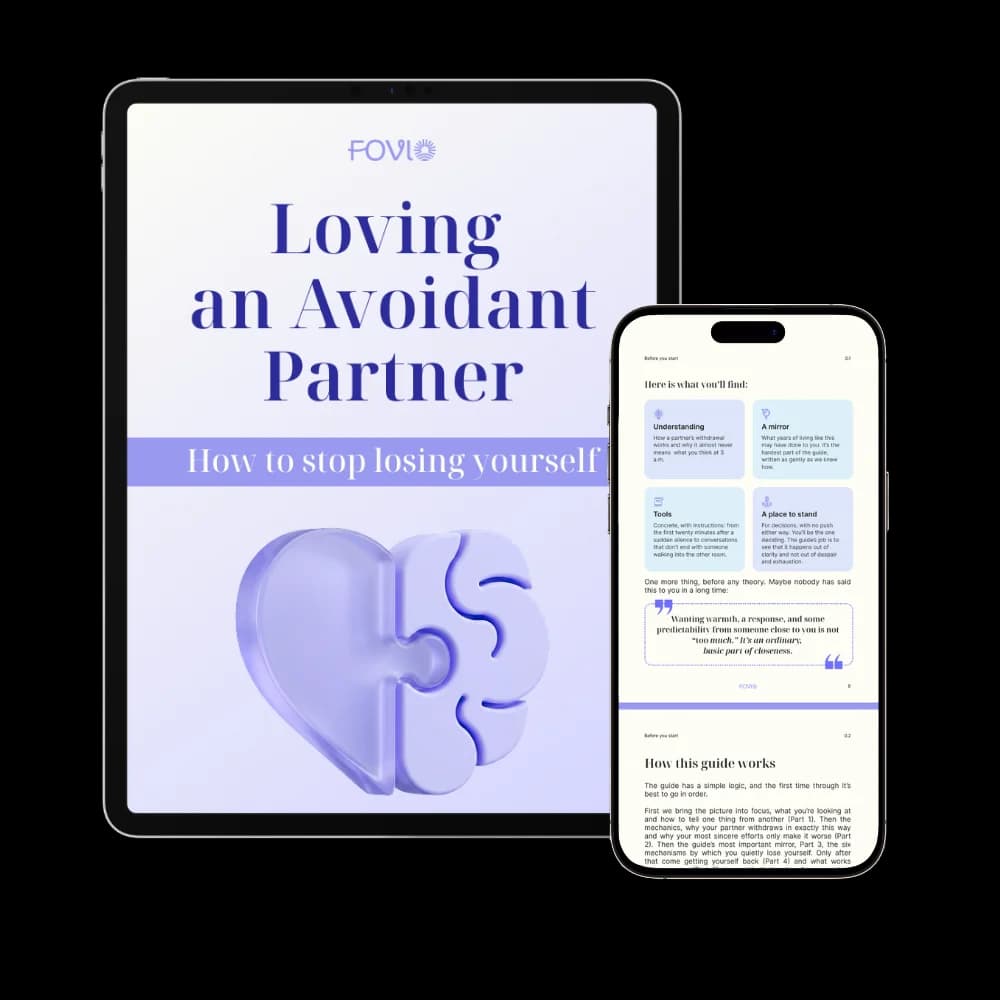
A practical Fovio guide
A practical guide for anyone tired of guessing why an avoidant partner pulls away again after a moment of closeness. It helps you understand what's happening between you, see the cycle that keeps repeating, stop losing yourself while you wait for things to change, and work out whether this relationship has a future.
Inside are 14 exercises, concrete tools and criteria you can use to judge whether anything is really changing.
€33.99old price €60
A PDF, sent to your email right after payment. The sale is handled by our payment partner Paddle. Details: Terms · Refunds
Psychological concepts and research - in plain language.

Reflection and practice for understanding your patterns.

A handy PDF arrives in your inbox after purchase.
What might be happening when a moment of warmth, honesty or closeness is followed by your partner shutting down again.
You'll work through real episodes and see where the pulling away starts, where anxiety kicks in and what sets the loop off again.
The self-loss scale shows how much the relationship affects your attention, your self-esteem, your plans and your own life.
How to get through the distance without acting on impulse, how to say what you need, and how to keep a conversation from turning into another chase.
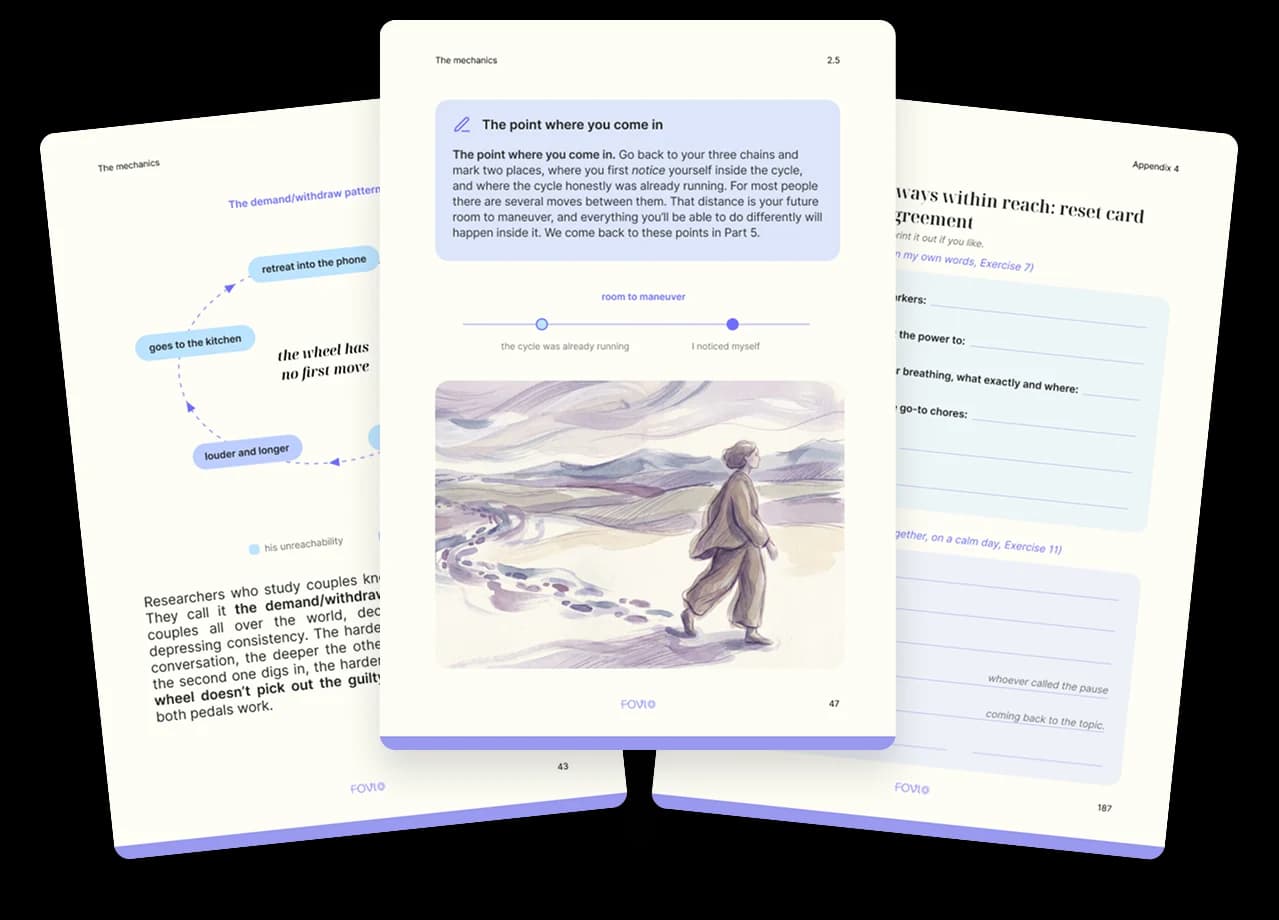
A warm-and-cold calendar, an observation log and a trial period show you the dynamic without guesswork, promises or waiting for the next thaw.
Why distance may appear after closeness, why important conversations often end in withdrawal, and why it all repeats again and again.
The self-loss scale, tasks and worked examples help you see how the relationship affects your attention, your self-esteem, your plans and your everyday life.
What to do when anxiety takes over, how to say the things that matter, and how to come back to a topic after a pause.
A calendar, an observation log and a trial period that help you tell real change from another temporary thaw.
Not on TikTok labels. On research into adult attachment and couple dynamics.
The Fovio team built this guide on an analysis of published scientific research and academic literature about adult attachment, close relationships, emotional regulation and couple dynamics.
In preparing the material we drew on the scientific concepts and findings published by John Bowlby, Mary Ainsworth, R. Chris Fraley, Phillip Shaver, Mario Mikulincer, John Gottman and other researchers. The guide is not a retelling or an adaptation of any single work. The scientific literature serves as the basis for understanding and explaining the psychological mechanisms described here.
We don't diagnose anyone and we don't decide a partner's personality type from a distance. The guide focuses on observable patterns of behaviour, on the dynamic that keeps repeating, and on how it affects you.
A full bibliography of the scientific sources is at the end of the guide.
Important! The guide does not diagnose your partner and does not replace work with a psychologist or another qualified professional. It is made as a self-guided tool for understanding your own patterns, watching the dynamic of your relationship and getting ready to make clearer decisions.
€33.99old price €60
A PDF, sent to your email right after payment. The sale is handled by our payment partner Paddle. Details: Terms · Refunds
Avoidant attachment usually describes a strong tendency to put more distance between yourself and someone else when closeness, dependence or emotional tension gets too intense.
That said, Fovio doesn't treat people as fixed, unchanging «types». With adult attachment it is more useful to look at how high anxiety and avoidance run, and at what a particular person actually does in a particular relationship.
Avoidant attachment is not a medical diagnosis.
Someone high in avoidance may step away from emotionally loaded conversations, ask for more space, go quiet during an argument, play down how much a close moment mattered, or become more distant after getting closer.
But similar behaviour can have other causes. That's why the Fovio guide has no «your partner is definitely avoidant» test - it works with observations and alternative explanations instead.
For some people closeness feels wanted and stressful at the same time. After an emotionally intense moment, a familiar strategy can kick in: getting a sense of autonomy back through distance.
That doesn't automatically mean the feelings aren't there. But the reverse isn't true either: feelings alone are no guarantee that your partner can build the kind of closeness you need.
Being able to feel attachment and being able to stay emotionally close are not the same thing.
A person can have strong feelings and still pull away regularly. So the Fovio guide suggests guessing less about «what someone feels inside» and looking more at what you can actually see in the relationship: whether they come back to the conversation, whether the initiative goes both ways, whether the pattern gets acknowledged and whether the changes hold.
A relationship like that is possible, but one person can't create mutual closeness for two.
You can change your part of the cycle, how conversations are set up and the way you steady yourself. But real change in a relationship needs at least some movement in return from the other side.
A separate part of the Fovio guide helps you see exactly that.
The Fovio guide walks you through an approach you can use: talk about one specific episode, keep it short, no labels and no sweeping accusations, make a clear request, and agree in advance when you'll come back to the topic if someone needs a pause.
At the same time, «gentler» doesn't mean «say nothing about what you need».
In a couple like that the anxious-avoidant cycle starts easily: the less available your partner seems, the stronger the pull to restore contact; the more the pressure builds, the further the other person withdraws.
The Fovio guide helps you see your part of that cycle without blaming yourself, and swap automatic reactions for steadier strategies.
The guide won't say «stay» or «leave» for you.
Instead, you'll gather data about the dynamic of the relationship, about your own changes and about how far your partner moves in return. A separate trial period helps you judge observable change over a stretch of time you set in advance, rather than promises and the emotion of the moment.
Not necessarily.
The Fovio guide looks separately at what happens when someone turns much warmer and more attentive once they think they might lose you, and a few weeks later everything is back where it was. The question that matters is whether the changes hold once that pressure is genuinely gone, and whether your partner starts taking initiative on their own.
It draws on scientific and academic work on adult attachment theory, the demand-withdraw pattern, emotional regulation, rumination, self-esteem, social support, interaction strategies in couples, and couples therapy.
The full bibliography is at the end of the guide.
No.
The guide is made for working on your own, but it is not psychotherapy, a medical service or a diagnosis. If how you're feeling has been affecting your sleep, your eating or your work for weeks, or it's getting hard to cope on your own, the guide recommends adding support from a qualified professional.
After payment you get a link to the PDF by email. Access stays yours forever. You can read the guide on a phone, tablet or computer, and copy the worksheets into your notes or print them out.